
 Rentals with Hot Tubs
 Hill Country View Rentals
 Pet-Friendly Rentals
 Rentals with Pools
 Waterfront Rentals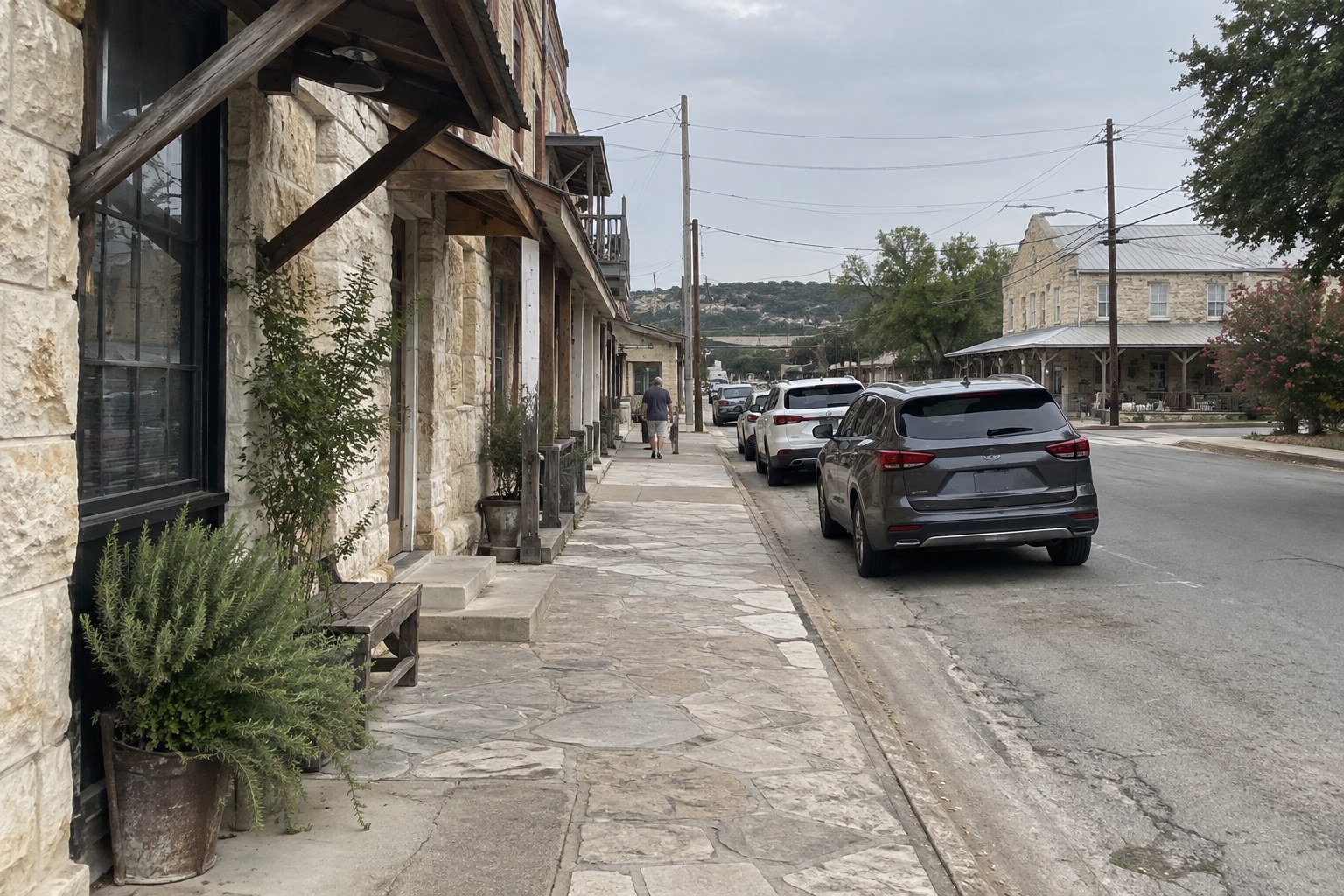
If you want the real story behind the limestone storefronts and half-timbered houses on Main Street, Fredericksburg, TX history goes back to 1846, when a group of German immigrants staked out a townsite on Baron's Creek and never looked back. At Stay Texas Hospitality Group, our Fredericksburg-based team fields questions about this history of Fredericksburg constantly from guests booking a stay, and we like sharing it, because knowing the story changes how you see the town.
Curious to see the historic district for yourself? Book a stay close to Main Street and start your visit right.
Key Takeaways
- Fredericksburg was founded in May 1846 by German immigrants sponsored by the Adelsverein and led by Commissioner-General John O. Meusebach.
- The 1847 Meusebach-Comanche Treaty is one of the few settler-Native treaties from that era never broken, and it let the colony survive its first years.
- Sunday houses, fachwerk framing, and native limestone construction still define the look of the historic district today.
- The Vereins Kirche and the National Museum of the Pacific War anchor two very different but equally important chapters of local history.
- Museum hours, tour schedules, and heritage event dates change from year to year, so confirm current details before you plan a visit.
How Fredericksburg Was Founded
Fredericksburg exists because a group of German noblemen formed a society to send settlers to Texas, and one of them turned out to be remarkably good at the job. The town's founding is really two stories: the organization that made it possible, and the man who got it right after early leadership nearly ruined it.
The Adelsverein and the Push for German Settlement
In 1842, a group of German noblemen organized the Adelsverein, formally the Society for the Protection of German Immigrants in Texas. Their goal was to recruit settlers from the German states and move them to land in the Republic of Texas. Between 1844 and 1847, the society brought an estimated 7,000 or more immigrants across the Atlantic, first to the Texas coast and then inland.
The first wave landed at Indian Point on the Gulf Coast and made its way to New Braunfels, a settlement the Adelsverein had established in 1845. New Braunfels filled up fast, and the society needed a second town further inland to handle the overflow and to anchor claims tied to the Fisher-Miller Land Grant, a huge tract between the Llano and San Saba rivers that the Republic of Texas had awarded on the condition it be surveyed and settled.
John O. Meusebach and the Founding of the Town
That is where John O. Meusebach comes in. He took over as the Adelsverein's commissioner-general in 1845, replacing Prince Carl of Solms-Braunfels, and inherited a society deep in debt with settlers arriving faster than land could be prepared for them. Meusebach scouted a site on Baron's (then called Barons) Creek, drawn by its water, stone, and timber, and arranged to buy roughly 10,000 acres on credit.
The first wagon train of about 120 settlers left New Braunfels and arrived at the new townsite on May 8, 1846. They named it Fredericksburg, honoring Prince Frederick of Prussia. Within its first year the settlement had a stockade, a scattering of log cabins, and the octagonal community church that would become the Vereins Kirche. It was a rough start, but it held.
| Milestone | Year | Why It Mattered |
|---|---|---|
| Adelsverein founded | 1842 | Organized German emigration to Texas |
| New Braunfels established | 1845 | First Adelsverein colony, filled quickly |
| Meusebach becomes commissioner-general | 1845 | Reorganized a struggling settlement effort |
| Fredericksburg founded | May 8, 1846 | Second inland colony on Baron's Creek |
| Meusebach-Comanche Treaty signed | May 9, 1847 | Secured peace for surveying and expansion |
The Meusebach-Comanche Treaty of 1847
A year after the town was founded, its future still was not settled. The Fisher-Miller Land Grant sat squarely in Penateka Comanche territory, and surveyors could not do their work safely without an agreement. Meusebach rode north to meet with Comanche leaders, including Buffalo Hump, Santa Anna, and Old Owl, near the San Saba River in early March 1847 to negotiate directly rather than wait for federal help that was not coming.
What the Treaty Actually Did
On May 9, 1847, Comanche chiefs came into Fredericksburg to formally sign the agreement. In exchange for a payment of goods, Meusebach secured safe passage for surveyors and settlers moving into the grant land, and both sides pledged not to disturb each other's people. The treaty was never ratified by the U.S. government, but historical markers in the region still commemorate it today.
Why It Still Matters
Historians point to the Meusebach-Comanche Treaty as one of the few agreements between settlers and a Native nation on the American frontier that was never formally broken by either side. It did not resolve every tension in the region, and conflict elsewhere in Texas continued for decades. But for the young colony at Fredericksburg, it meant surveyors could work, settlers could move onto grant land, and the town could grow instead of fortify. You can read the full context of the treaty at the Pioneer Museum, one of several stops covered in our roundup of Fredericksburg museums, which displays artifacts and records tied to the negotiation alongside the rest of Gillespie County's founding story.
Sunday Houses and the Rhythm of Rural Life
One of the more distinctive features of Fredericksburg, TX history is a building type you will not find in most of Texas: the Sunday house. Farm families who lived out on the land grant, sometimes ten or twenty miles from town, needed a place to stay overnight when they came in for church, supplies, or market day.
What a Sunday House Looked Like
A typical Sunday house was small by design, often just one or two small rooms with a sleeping loft above, reached by an outside staircase or ladder. Families used them Saturday night through Sunday, then locked up and rode home for the week. Most were built between the 1880s and 1920s, and they show up in both frame and stone construction.
Why the Custom Faded and Where to See One Today
Better roads and the automobile made the overnight trip into town unnecessary by the 1920s, and the custom declined. A number of Sunday houses survive around the historic district, and many now operate as bed-and-breakfast lodging, which is a fitting second life for buildings meant to shelter travelers for a night. Walking the blocks around Main Street and the surrounding residential streets is still the best way to spot one, tucked behind a larger family home on the same lot.
Fachwerk, Limestone, and the Look of the Historic District
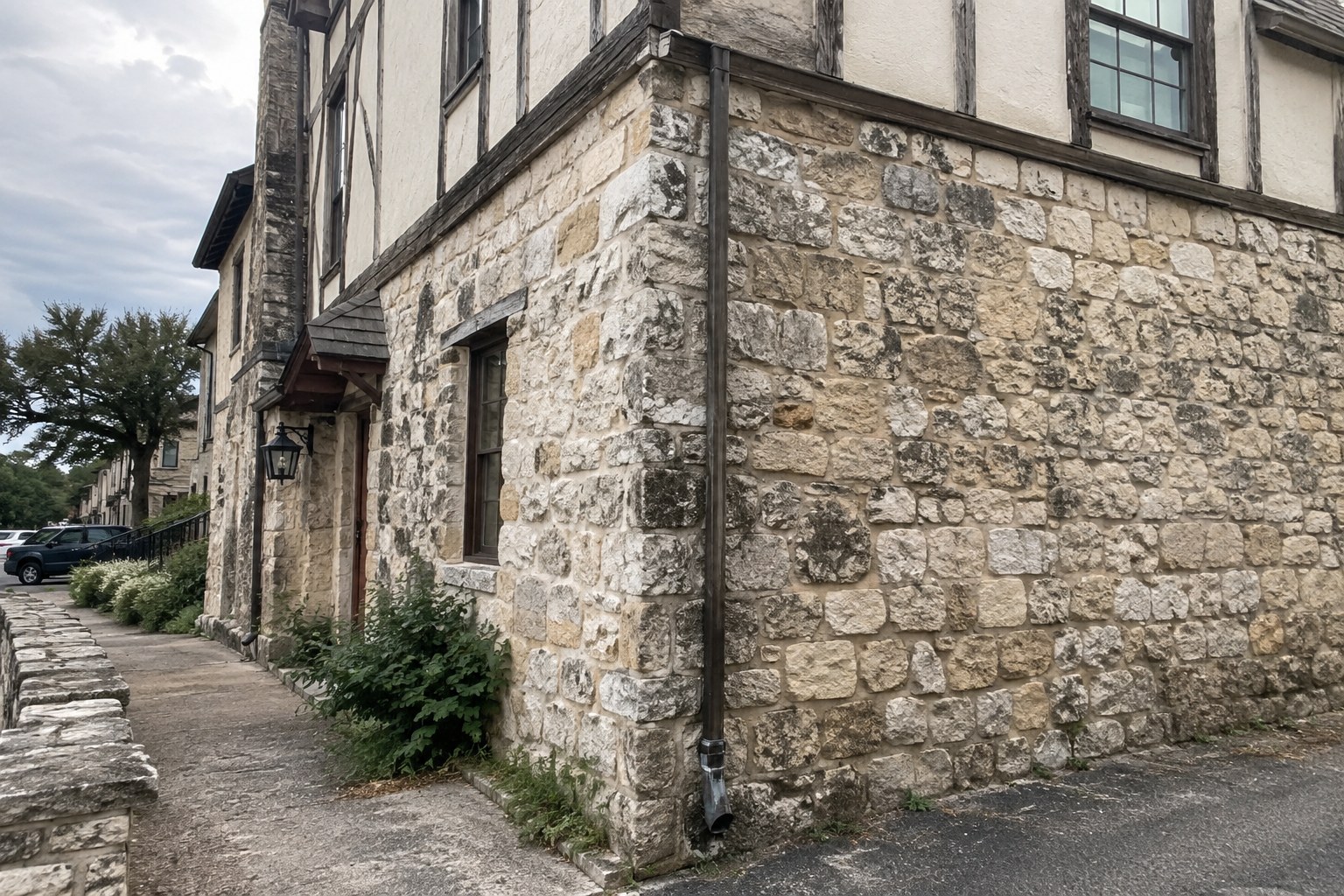
The architecture of Fredericksburg tells the founding story as clearly as any museum placard. Settlers built with what they knew from home and what the land actually offered, and the combination produced a look you do not see anywhere else in Texas.
German Vernacular Building Methods
Early settlers brought fachwerk, a half-timbered framing method using exposed wood beams infilled with stone, brick, or clay and straw. As stonemasons among the settlers found the local limestone easy to quarry and work, construction shifted toward load-bearing stone walls, often finished with a lime-based coating called German smear that softened the rubble masonry's rough texture. Ground floors done in hewn stone with lighter framing above became a common local variation, blending both traditions.
The Fredericksburg Historic District
Much of this architecture survives in the Fredericksburg Historic District, added to the National Register of Historic Places on October 14, 1970. The district follows the town's original grid platted in 1846 and includes dozens of recognized points of historic interest, from churches and civic buildings to family homes and former Sunday houses. Walking it slowly, block by block, is the clearest way to see 180 years of local building tradition in one place.
Landmarks That Anchor the Story
A handful of sites do the heaviest lifting when it comes to understanding local history, and each one covers a different era.
Vereins Kirche and the Marktplatz
The original Vereins Kirche, an octagonal community building, went up in the settlement's first year and served as church, school, fort, and town hall all at once. That original structure was torn down in 1897, but a faithful replica was built by the Gillespie County Historical Society with help from the Civil Works Administration and completed in 1936, and it still stands at the center of the Marktplatz on West Main Street as a small museum on the town's founding. The surrounding Marktplatz remains the community's gathering space for festivals and holiday events throughout the year.
Admiral Nimitz and the National Museum of the Pacific War
Fredericksburg's history also produced a very different kind of legacy. Fleet Admiral Chester W. Nimitz, who commanded U.S. Pacific forces during World War II, was born here in 1885, near his grandfather's Nimitz Hotel on Main Street, a building later styled with steamboat-like additions. Today that same block and campus hold the National Museum of the Pacific War, a Smithsonian-affiliated museum covering the entire Pacific theater with exhibits, a memorial courtyard, and outdoor combat zone displays. It is one of the few museums in the country dedicated solely to that theater of the war, and it draws visitors well beyond the Hill Country.
Texas German and Living Heritage
Language is one of the harder parts of this history to see, but it shaped the town for a century. Texas German, a distinct dialect that developed among Hill Country settlers, was the everyday language of home, school, and church here for generations, with speakers numbering roughly 160,000 across the state at its peak around 1940.
A Dialect in Decline, Preserved by Researchers
English-only school policies and the social pressures of two world wars pushed Texas German into steady decline through the twentieth century. Linguists at the Texas German Dialect Project have spent years recording remaining speakers to preserve the dialect before it disappears, and the White Oak School building at the Pioneer Museum still shows the classroom setting where German instruction once took place.
Where Heritage Shows Up Today
You will still hear German phrases on shop signs, in church bulletins, and in the names printed on old family gravestones around town. Heritage events carry the tradition forward each year, including Oktoberfest on the Marktplatz every fall and the holiday season, when the square's German Christmas traditions, including a towering Weihnachtspyramide, take over downtown Fredericksburg. A plate of German food after a day at the museums is one of the simplest ways to feel the heritage rather than just read about it. Confirm dates before you plan a trip, since festival schedules shift from year to year.
Ready to make history part of your trip? Check current availability for a stay close enough to walk the historic district on foot.
Walking the History Yourself
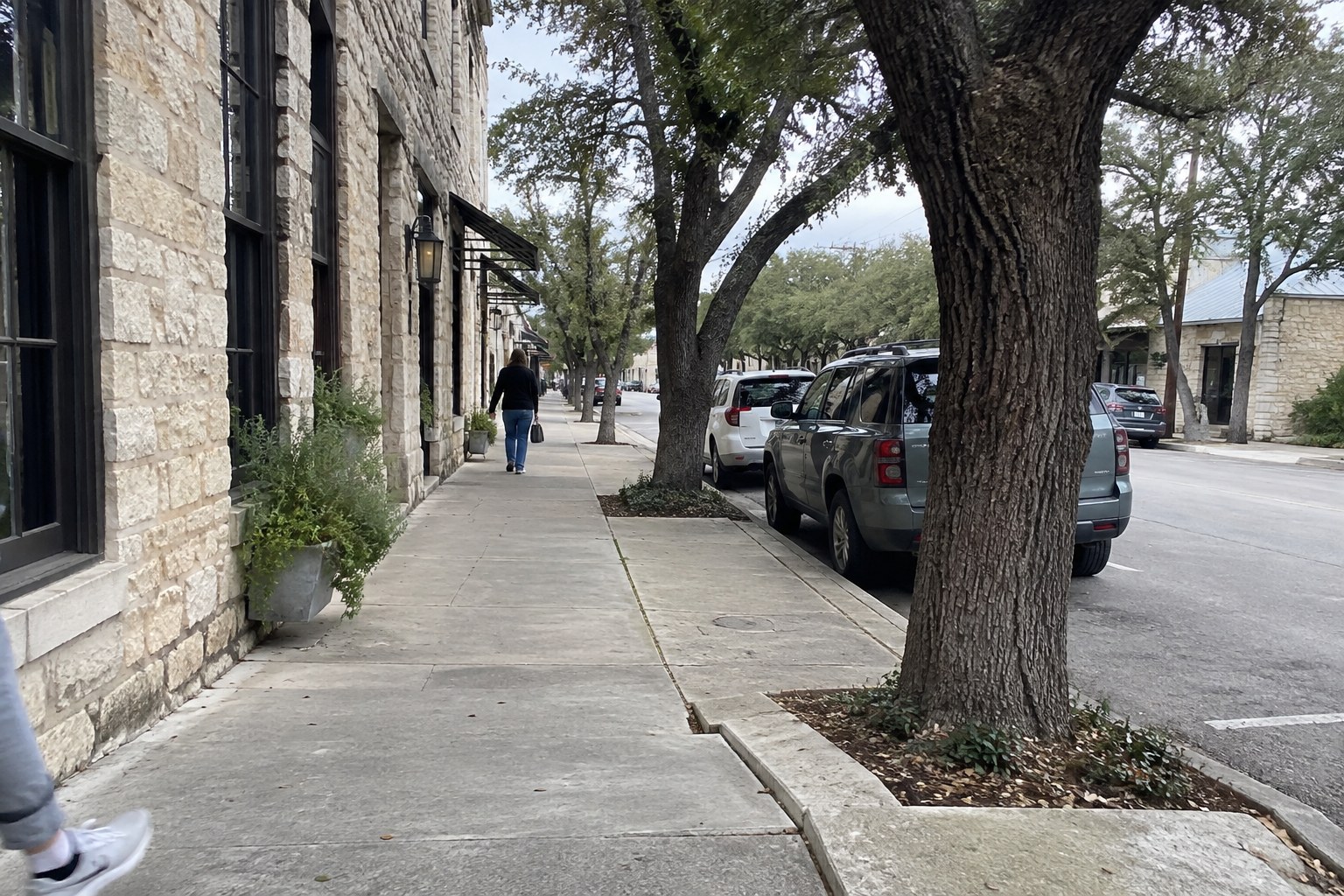
You do not need a guide or a car to cover most of this story. Fredericksburg's historic core is compact enough to walk in a morning, with the two major museum campuses roughly six blocks apart on Main Street.
A Self-Guided Route Through the Historic District
Start at the Vereins Kirche on the Marktplatz and take a few minutes with the exhibits inside before stepping back out onto the square where the town's first structures once stood. From there, walk west along Main Street toward the Pioneer Museum complex, stopping to notice the limestone facades and fachwerk detailing on shopfronts and homes along the way. Plan on two to three hours if you want time inside both museum campuses rather than just the walk between them.
Extending the Route to the Pacific War Museum
From the Pioneer Museum, backtrack east along Main Street past the Marktplatz to reach the National Museum of the Pacific War campus, about six blocks in total. Free walking tour maps of the National Historic District are available at the Visitor Information Center on East Austin Street if you want more of the district's other historic points along the way, including homes and churches not covered above. Comfortable shoes matter more than timing here. Sidewalks are uneven in places and the limestone can get warm underfoot on summer afternoons.
Basing Yourself Near the Historic District
Where you stay changes how much of this history you actually see on foot versus from a car. Guests based in central Fredericksburg can walk to both museum campuses and back without needing to move a vehicle all day, which matters most in summer heat. Our Fredericksburg vacation rentals put you within easy walking distance of Main Street, and travelers extending the trip toward the small German dance hall town covered in our piece on Luckenbach, Texas can still keep the historic district an easy drive away. Call us at (830) 999-2694 and our local team can point you toward a property that fits how much walking you want to do.
About Stay Texas Hospitality Group
Stay Texas Hospitality Group has managed vacation rentals across the Texas Hill Country for more than a decade, with our home office right on East Main Street in Fredericksburg. Guests often come to us wanting to understand the town's German founding, its treaty history, and its historic architecture before they arrive, and we point them toward the right neighborhoods, museums, and walking routes to see it firsthand.
Frequently Asked Questions
When Was Fredericksburg, Texas Founded?
Fredericksburg was founded on May 8, 1846, when the first wagon train of German settlers arrived on Baron's Creek under the direction of Commissioner-General John O. Meusebach. The Adelsverein sponsored the colony as a second inland settlement after New Braunfels filled up. The town was named for Prince Frederick of Prussia.
What Was the Meusebach-Comanche Treaty?
It was a peace agreement signed on May 9, 1847, between John O. Meusebach and Penateka Comanche leaders, allowing settlers and surveyors safe passage onto land within the Fisher-Miller Land Grant. Both sides pledged not to harm each other's people. Historians often cite it as one of the few frontier treaties never formally broken by either party.
What Is a Sunday House?
A Sunday house was a small overnight cottage, often just one room with a sleeping loft, built by farm families who lived far from town. They stayed Saturday night through church on Sunday before heading home to work the land. Many survive today in the historic district, some now used as small lodging properties.
What Is the Vereins Kirche?
The Vereins Kirche is a replica of Fredericksburg's original 1847 octagonal community building, which served as church, school, fort, and town hall in the settlement's earliest years. The current replica, completed in 1936 for the Texas Centennial, stands on the Marktplatz on West Main Street and now operates as a small museum on the town's founding. Confirm current hours before visiting.
Why Is Fredericksburg Connected to Admiral Nimitz and the Pacific War?
Fleet Admiral Chester W. Nimitz, who led U.S. Pacific forces in World War II, was born in Fredericksburg in 1885, near his grandfather's Nimitz Hotel on Main Street. That connection led to the creation of the National Museum of the Pacific War, which includes the restored hotel, a major museum covering the full Pacific theater. It remains one of the town's most visited historic attractions.
Is Texas German Still Spoken in Fredericksburg?
A small number of older residents still speak Texas German, a dialect that was once the everyday language of the town and surrounding Hill Country. Speakers have declined sharply since the dialect's peak around 1940, and researchers have worked to record remaining speakers before the dialect disappears entirely. Traces of it remain in signage, church life, and local family names.
From the founding of the colony in 1846 through the Meusebach-Comanche Treaty, Sunday houses, and the museums that anchor Main Street today, Fredericksburg, TX history is not something you learn from a plaque and move past. It's the reason the town looks and feels the way it does. Call (830) 999-2694 or reach out online, and our team on East Main Street in Fredericksburg can help you plan a stay built around it.
Ready to Get Started with Stay Texas Hospitality Group?
Call (830) 999-2694 to talk with our Fredericksburg-based team about a stay near the historic district. We can help you find a base close enough to walk Main Street, the Marktplatz, and both museum campuses, and we're happy to answer questions about the town's history along the way.