
 Rentals with Hot Tubs
 Hill Country View Rentals
 Pet-Friendly Rentals
 Rentals with Pools
 Waterfront Rentals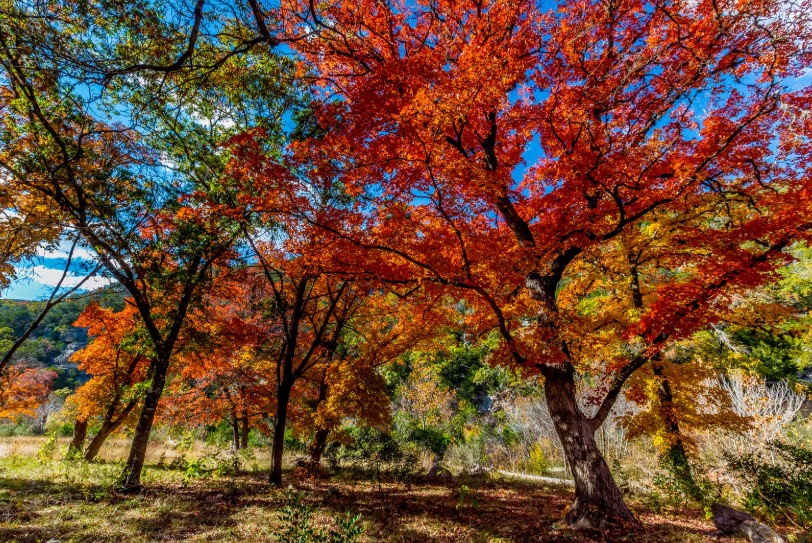
Most of Texas does not turn. In the fall, the live oaks stay green, the cedar stays green, and the rolling hills of the Hill Country look much the same in November as they do in April. Then there is Lost Maples State Natural Area, which does not follow those rules. Tucked into the rugged canyon country of Bandera County, about five miles north of the tiny community of Vanderpool, Lost Maples transforms each October into something that surprises even lifelong Texans: a blazing display of red, orange, and gold that draws visitors from across the state and beyond.
The park covers roughly 2,900 acres along the upper Sabinal River, designated a state natural area in 1979 and recognized as a National Natural Landmark in 1980. It is not just beautiful. It is biologically rare, home to an ancient population of Uvalde bigtooth maple trees that are living relics of a wetter, cooler Texas from thousands of years ago. Whether you are planning a fall foliage trip, a spring hiking weekend, or a dark-sky stargazing night, this guide covers everything you need to know before you visit.
The Ancient Trees That Give the Park Its Name
The bigtooth maple, known scientifically as Acer grandidentatum, is not native to the Texas most people picture. It belongs to the same family as the sugar maples of New England, and under the right autumn conditions it produces the same brilliant reds and oranges that draw leaf-peepers to Vermont every October. The question is why it is growing in the Texas Hill Country at all.
The answer reaches back roughly 10,000 years, to the end of the last ice age. During the Pleistocene epoch, the Hill Country was cooler and wetter, covered by hardwood forests in which the bigtooth maple was widespread. As the ice sheets receded and the climate gradually warmed and dried, most of those forests died out. The maples survived only where the landscape gave them shelter: in the deep, steep-sided limestone canyons of the Sabinal and Frio river drainages, where spring-fed groundwater stays cool, where canyon walls shade the soil, and where a microclimate persists that the surrounding plateau cannot offer. Scientists call these populations relict flora, and they are botanical time capsules of an ancient Texas that no longer exists outside of a handful of protected canyons.
The bigtooth maples at Lost Maples are genuinely old. Individual trees live for hundreds of years. Their leaves are smaller than those of northern maple species, an evolutionary adaptation to the dry Hill Country environment. They thrive in the shallow, rocky, alkaline caliche soils that most other trees find inhospitable. The state champion bigtooth maple stands at the head of the park's Maple Trail, rising 40 feet from the Sabinal Canyon floor. The park was acquired specifically to protect this population, and the designation as a natural area rather than a state park reflects that preservation-first mandate.
The intensity of the fall color depends heavily on weather. Cool nights, warm days, and a dry autumn produce the most vivid display. A warm, wet fall produces more muted tones. In years when the maples are seeding heavily, which happens roughly every five to seven years, color development can be minimal regardless of weather. Texas Parks and Wildlife publishes a Fall Foliage Report each autumn with real-time updates on peak color conditions. Checking it before you book is not optional if the foliage is your primary reason for visiting.
When to Visit and How to Plan Around the Seasons
Fall is Lost Maples at its most famous, but it is also Lost Maples at its most crowded and its most reservation-dependent. Peak color typically arrives in late October and runs through mid-November, though the exact timing shifts from year to year. On fall weekends, the park fills to capacity and turns away visitors without reservations. Day-use passes and campsites require advance booking through the Texas Parks and Wildlife online system, often weeks out. Arriving without a reservation on a Saturday in late October is a reliable way to spend an hour in line and then get turned around at the gate.
Spring offers a quieter, greener version of the same trails, with fewer crowds and the added reward of wildflowers blooming along the Sabinal River. The Texas wildflower season peaks in March and April, and while Lost Maples is not primarily known for wildflowers, the surrounding Hill Country roads are spectacular during that stretch. Spring is arguably the best time to visit for hikers who want a full day on the trails without fighting for parking or waiting for the shuttle.
Summer brings genuine heat to these canyon trails, with temperatures pushing into the mid-90s and little shade above the canyon floor. Early morning starts before 8 a.m. are essential, and the longer trails should not be attempted midday between June and August without serious water planning. The park allows two quarts per hour of activity as a minimum guideline. That said, the Sabinal River at the canyon bottom offers cool wading and swimming, which makes a summer visit workable for those who manage the heat.
Winter brings the park's quietest and most contemplative version. Crowds are thin, the light through bare branches is beautiful, and the dark skies that make Lost Maples one of the best stargazing destinations in the Hill Country are at their clearest in cold, dry December and January nights. The park's designation as a Dark Sky preserve means that light pollution from surrounding areas is actively managed. On a clear winter night, the Milky Way is visible from the campground.
The Trails: What to Hike and What to Expect
Lost Maples has more than 10 miles of trails distributed across terrain that is consistently more rugged than first-time visitors expect. The canyon landscape means significant elevation change, loose rock, steep steps, and creek crossings on most routes. Trails are suitable for hiking and biking for the first mile from the trailhead, after which they become hiking-only. Strollers and most mobility aids are not appropriate for the trail system beyond the flat entry sections.
The Maple Trail (0.8 miles, easy)
The shortest and most accessible route in the park, the Maple Trail loops through the heart of the bigtooth maple grove along the Sabinal River. This is where the state champion bigtooth stands, where the canyon walls close in overhead, and where fall color is densest. The trail passes through limestone boulder fields, by spring-fed seeps, and alongside a river that is clear and slow-moving in most seasons. For visitors with limited time or mobility, this trail delivers more visual reward per mile than any other route in the park.
The East Trail (5.2 miles, strenuous)
The East Trail is the park's signature long route and the one most visitors mean when they describe hiking Lost Maples as a genuine workout. The trail begins near the river and climbs steadily to the caprock above the canyon, gaining significant elevation along the way. Along the route are two of the park's most photographed features: Monkey Rock, a limestone formation shaped by erosion into a figure that genuinely resembles a seated primate, and the Grotto, a fern-draped alcove where springs seep from the canyon wall year-round. The panoramic views from the top of the East Trail overlook of the Sabinal River valley below are among the most rewarding in all of hiking in the Texas Hill Country. Plan at least three to four hours, carry at least two liters of water, and wear proper trail shoes.
The West Trail (4.5 miles, moderate)
The West Trail is slightly less demanding than the East and considerably less crowded, which makes it a worthwhile choice for visitors who want a long hike without the competition for overlooking spots that the East Trail attracts on fall weekends. The trail winds through the canyon to a scenic pond and out to the primitive camping areas, passing a series of springs that seep through the limestone at various points along the route. One particular spring, marked as a point of interest on the park map, collects in a small pool where fish swim and fallen leaves accumulate in still water. It is one of those quiet spots that stays with you longer than the more dramatic overlooks do.
The East-West Loop (10.5 miles, difficult)
Combining both trail systems into a single full-day route, the East-West Loop traces the park's outer perimeter and encompasses the best of both sides. The total elevation gain exceeds 1,370 feet. This is a serious commitment that should only be attempted by fit hikers with ample water, a trail map, sun protection, and a realistic turnaround time established before departing. The reward is a comprehensive view of the park's full range of terrain, from canyon floors to plateau grasslands, from spring-fed seeps to limestone cliff faces.
Camping at Lost Maples State Natural Area
The park offers two distinct camping experiences. The developed campground near the park headquarters has 30 sites with water and 30 or 50-amp electrical hookups, picnic tables, fire rings, and access to restroom and shower facilities. These are drive-up sites that accommodate tents, trailers, and RVs, and they are the only campground option where campfires in designated rings are permitted. Nightly rates are $20 per site. Reservations are required and fill well in advance during fall season.
The primitive backcountry sites are reached by hiking on the East or West Trail, with 50 designated spots spread along both routes. These sites have no water, no electricity, and no fire rings, and they are some of the best hike-in camping available in the Texas Hill Country. Only containerized cooking is allowed in the primitive area, and campfires are prohibited due to the risk of wildfire and ground scarring in the canyon environment. The reward for carrying your gear in is genuine solitude, dark skies unobstructed by neighboring campers' lights, and the experience of waking up inside the canyon rather than beside a parking lot.
No fishing license is required to fish from the shore or a pier within a Texas state natural area. The Sabinal River and Can Creek both hold fish year-round. For visitors who have already explored the broader network of fishing in the Hill Country, the Sabinal offers a quieter, less-visited complement to the more famous trout waters elsewhere in the region.
Wildlife, Birdwatching, and What You Might See
The canyon landscape of Lost Maples creates a layered habitat that supports an unusually diverse range of wildlife for its size. White-tailed deer, gray foxes, raccoons, armadillos, rock squirrels, bobcats, and javelinas all inhabit the park. Mountain lions are present but rarely seen. The Sabinal River corridor draws a range of wildlife to water, and early morning hours on any of the trails offer the best chance of seeing animals moving before the heat sets in.
The park is particularly significant for birdwatchers. The endangered golden-cheeked warbler and the black-capped vireo, both federally protected species, nest and feed in the park during spring and early summer. The canyon's position along a migratory corridor means that spring and fall bring a rotating cast of warblers, flycatchers, thrushes, and raptors passing through. The green kingfisher, a small and brilliant bird uncommon in most of Texas, is a year-round resident of the Sabinal River. The park maintains a Birds of Lost Maples checklist available at the visitor center, which is worth picking up even for casual observers.
Practical Information Before You Go
The park address is 37221 FM 187, Vanderpool, TX 78885. From San Antonio, the drive takes approximately two hours heading northwest. The day-use entrance fee is $6 per person for visitors ages 13 and older, with children 12 and under admitted free. A Texas State Parks Pass covers entry at Lost Maples and more than 80 other parks and natural areas statewide for a full year.
The gate is open from 8 a.m. to 10 p.m. daily. The park office operates from 8 a.m. to 4:30 p.m. During fall foliage season, day-use entry is timed and reserved in specific windows through the TPWD online system, with passes bookable up to one month in advance. Cell service in the area is limited to nonexistent, so download your reservation confirmation, trail maps, and directions before you lose signal. The park store at the visitor center sells firewood, ice, and basic gift items, but no food or drinks beyond what the rangers may have on hand.
Pets are welcome in developed areas, including campsites and picnic areas, on a leash. Current TPWD policy restricts pets on many of the natural area's trails, so confirm the current rules at the park office on arrival, as restrictions have shifted over time. Firewood may not be collected from the natural area; bring your own or purchase it at the visitor center. All trash must be packed out. There is no water on the trails themselves, only at the developed campground spigots near headquarters.
What to Do Beyond the Park
Lost Maples sits in one of the more remote corners of the Hill Country, which is part of its appeal and part of the planning challenge. The nearest town of any size is Kerrville, roughly 45 miles to the northeast, which has a full range of restaurants, grocery stores, and services. Bandera, about 35 miles to the east, calls itself the Cowboy Capital of the World and delivers on that title with dance halls, rodeo events, and dude ranches. For visitors who want to combine Lost Maples with something more developed, Fredericksburg sits about 65 miles to the northeast, making it a reasonable base camp for a multi-day Hill Country trip. Our guide to the best places to visit in Texas covers the broader region well.
Garner State Park, about 40 miles southwest of Lost Maples near Concan, is the natural companion trip for a two-park Hill Country weekend. The Frio River at Garner is spring-fed, clear, and ice-cold even in August, and the hiking on Mount Baldy offers Hill Country views from a completely different angle than the Sabinal Canyon. Garner is one of the most visited state parks in Texas for good reason, and pairing it with Lost Maples makes for a spectacular two-day itinerary.
For couples, the combination of Lost Maples' fall foliage and the wider Hill Country's wine country, spa options, and scenic drives adds up to one of the better romantic things to do in the Hill Country on a crisp autumn weekend. And for riders, the surrounding ranch roads and rural terrain around Vanderpool are among the most scenic in the state for horseback riding in the Hill Country.
Lost Maples is also among the state parks near Fredericksburg that reward visitors who base themselves in the wine country area and make a day trip west. The drive from Fredericksburg through the Hill Country to Vanderpool on FM 187 is one of the more scenic stretches of road in Texas regardless of the season.
Frequently Asked Questions About Lost Maples State Natural Area
When is peak fall foliage at Lost Maples?
Peak color typically arrives during the last two weeks of October and the first two weeks of November, though the precise timing varies every year based on nighttime temperatures and autumn rainfall. A dry fall with cold nights produces the most vivid reds and oranges. A warm, wet fall mutes the display. Texas Parks and Wildlife publishes a Fall Foliage Report on their website each autumn with real-time updates. Always check it within a week of your planned visit and confirm that reservations are in place before you make the drive.
Do I need a reservation to visit Lost Maples?
Yes, and emphatically so during fall foliage season. Day-use entry is timed and requires advance reservations on fall weekends, and the park reaches capacity and closes to unreserved visitors regularly from late October through mid-November. Camping reservations fill weeks in advance during peak season. Outside of fall, reservations are strongly recommended but more flexible. Book through the Texas Parks and Wildlife online reservation system, and purchase your reservation up to one month ahead for day-use passes.
How difficult are the hiking trails?
The Maple Trail is the only genuinely easy route in the park, running 0.8 miles through the maple grove on relatively flat terrain. All other trails involve significant elevation gain, loose limestone rock, and steep sections that require proper footwear and physical fitness. The East Trail is the most challenging at 5.2 miles and should not be underestimated, particularly in summer heat. Plan on one quart of water per hour of hiking as a minimum, and account for the return journey when assessing how long a route will take.
Can I camp at Lost Maples without a reservation?
During fall foliage season, no. Campsites are fully reserved on fall weekends and frequently throughout the week as well. Outside of peak season, walk-up camping may be possible but is never guaranteed. The park's 30 developed sites and 50 primitive backcountry sites together represent limited capacity for a park that sees roughly 200,000 visitors per year. Making a reservation through the TPWD system is always the right approach.
Is Lost Maples worth visiting outside of fall?
Absolutely. Spring offers wildflowers, mild temperatures, bird nesting season for the golden-cheeked warbler and black-capped vireo, and far smaller crowds than fall. Winter provides the park's best stargazing conditions and a peaceful, uncrowded version of the trails. Summer is the hardest season but remains workable with early starts and realistic expectations about heat. The canyon's permanent springs, the Sabinal River, and the park's remarkable wildlife make every season worth the drive.
What should I pack for a day visit?
For any visit: at least two liters of water per person, closed-toe shoes with grip, sunscreen, and a downloaded trail map since cell service is unreliable throughout the area. In fall, add layers for cooler canyon temperatures in the morning and evening. In summer, add a sun hat, extra water, and a firm commitment to turning around if you feel overheated. The park has no food concession, so bring lunch and snacks for any hike longer than an hour.
About Stay Texas Hospitality Group
Stay Texas Hospitality Group offers a carefully curated collection of vacation rentals across the Texas Hill Country, with properties near the best natural areas, state parks, and scenic drives the region has to offer. Whether you are planning a fall foliage trip to Lost Maples or a full Hill Country itinerary, properties in Kerrville, Comfort, Fredericksburg, and Wimberley put you within easy reach of Lost Maples and the wider network of Hill Country experiences. Every Stay Texas property is chosen for its character, comfort, and location.
Plan Your Lost Maples Getaway with Stay Texas
Lost Maples is one of those parks that deserves more than a rushed day trip. Give yourself a full weekend and a comfortable place to return to after the trails. Browse our Kerrville vacation rentals, Fredericksburg vacation rentals, and Wimberley vacation rentals to find a property that suits your group and puts you within easy reach of the park. Call us at (830) 999-2694 or explore the full Stay Texas collection to book your Hill Country stay today.